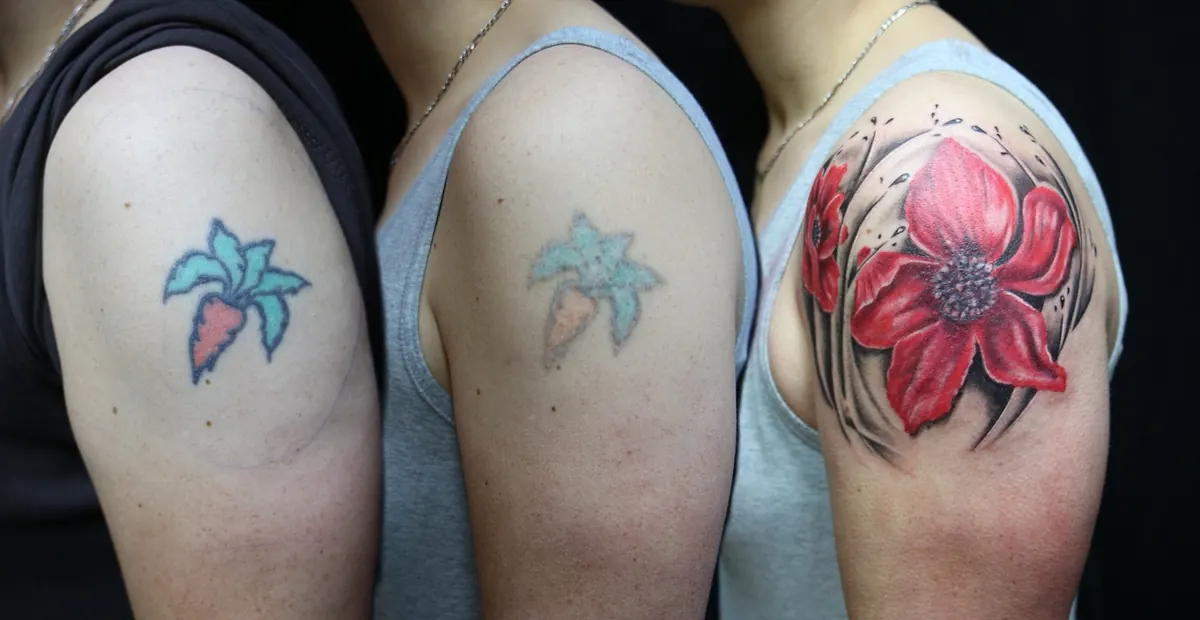
Most tattoos aren't disasters. They're decisions that made perfect sense at the time — a name, a band around the arm, a design pulled off a flash sheet after a long night. Then a decade passes, your taste shifts, and the thing on your forearm starts to feel less like a marker of who you were and more like a jacket you can't take off. A cover-up is one answer. It isn't the only one, and it's rarely as simple as picking something bigger. Here's how to get it right.
You cannot put light ink over dark ink and expect the dark ink to vanish. New pigment sits in the same layer of skin as the old, and the old keeps showing through. That's why a cover-up almost always means going darker and larger than what's already there — not slightly larger, but noticeably, with enough solid black or saturated colour to build a new image on top of the old one.
A fine-line sprig of flowers will not hide a heavy black armband. A bold peony with deep shading might. Faded grey-wash work from fifteen years ago is often straightforward to cover. Dense tribal from the same era is a project, and occasionally a project that needs help before the needle comes out at all.
Texture matters too. If the original tattoo was overworked, or has raised scarring, that surface stays even once the ink is hidden. Blowouts — where pigment has spread softly under the skin — can limit how crisp the new edges will ever look. You're not starting from blank paper; you're starting from a page someone already drew on in permanent marker.
When an artist says they'll "work with what's there", this is what they mean. Warm tones cover warm tones, cool covers cool. A deep blue-green can absorb a faded red. A rich burgundy can knock back a muddy orange. Black sits over almost anything, but nothing sits over black, so a cover-up built in solid black is a commitment to that shape for good.
Light pigments are stubborn in the opposite way. Pale blue, thin pink and yellow reflect a lot of light and sit close to some skin tones, which makes them awkward to bury and often the reason an artist suggests lasering first rather than last.
Skin tone changes the maths. On deeper skin tones, high-contrast black and richly saturated colour tend to read far more strongly than pale washes, which can turn ashy as they heal. A good artist will raise this with you before you fall in love with a reference photo taken on someone else's arm.
This is the part most people miss. Laser can lighten an old tattoo just enough to widen your options enormously — turning a design that could only ever be covered by something heavy and dark into one where you can actually choose. You don't need it gone. You need it pale enough for the new design to sit over.
Sessions are spaced weeks apart so the skin can recover and your body can clear the broken-down pigment. That's why laser prep adds months to a timeline rather than days. A light old tattoo might need only a couple of sessions; dense black can take considerably more.
Not everyone is a suitable candidate. Laser carries a risk of pigment change, especially on deeper skin tones, and isn't appropriate with some skin conditions, active infections or a history of keloid scarring. This is a medical procedure, so book with a qualified practitioner, and speak to a doctor or dermatologist if you have any concerns about your skin. Cheap, unregulated laser can cost you the skin you were trying to save.
Bring photographs of the existing tattoo in daylight, healed, straight on and side on. Bring references for the direction you want. Don't edit the old tattoo out of the photo — the artist needs to see it as it actually is. Some will trace it, some will draw directly onto skin, some will mock a design up digitally over a picture of your arm.
Then ask:
Expect honesty, and be suspicious of anyone who says yes to everything. A cover-up with no compromise, no extra size and no laser is usually a cover-up that won't work. The artist who tells you to come back in six months with a lighter tattoo is doing you a favour.
Be careful with negative space. Leaving areas blank only works if the old tattoo underneath is already faint; otherwise you've simply left a window onto the thing you were hiding.
Cover-ups are worked harder than fresh tattoos. More passes, more ink, more stress on the skin — so expect a heavier heal, more swelling and more flaking than you might remember from last time. Follow your artist's aftercare instructions rather than a routine you found online, and don't judge the result at day five. Fresh work always looks bolder than it settles, and old ink can reappear slightly as everything calms down. A good artist plans for that from the start.
Give yourself a fortnight. Collect two or three artist portfolios that include healed cover-up work, not just fresh, and check whether their style suits what you want rather than the other way round. Get a clear idea of total cost, session count and timeline in writing before you pay a deposit. And if your old tattoo needs laser first, deal with that now rather than hoping it won't matter. The best cover-ups aren't the ones that hide the most — they're the ones where nobody would ever guess there was anything underneath.
Photo: Herco / Pixabay
Vegan tattoos involve more than ink — stencil fluid, gloves and aftercare all count. Here's what to ask your artist...
A practical guide to tattoo pain by placement, from sharp ribs and sternum to tender ankles and feet, plus skin...
A season-by-season guide to UK tattoo conventions, from spring's regional shows to autumn's big-city flagships, with...

Your weekly dose of tattoo culture and news..
